Kunzang Gongdu Ngondro: The Introduction
The most recent update to the app calls for a post explaining its context, here's a few words about it:
The Kunzang Gongdu Ngondro is a text comprising the preliminary practices for the Dzogchen cycle revealed by the Tertön Pema Lingpa called The Synthesis of the Entire Wisdom Mind of Samantabhadra (Künzang Gongpa Kündü).
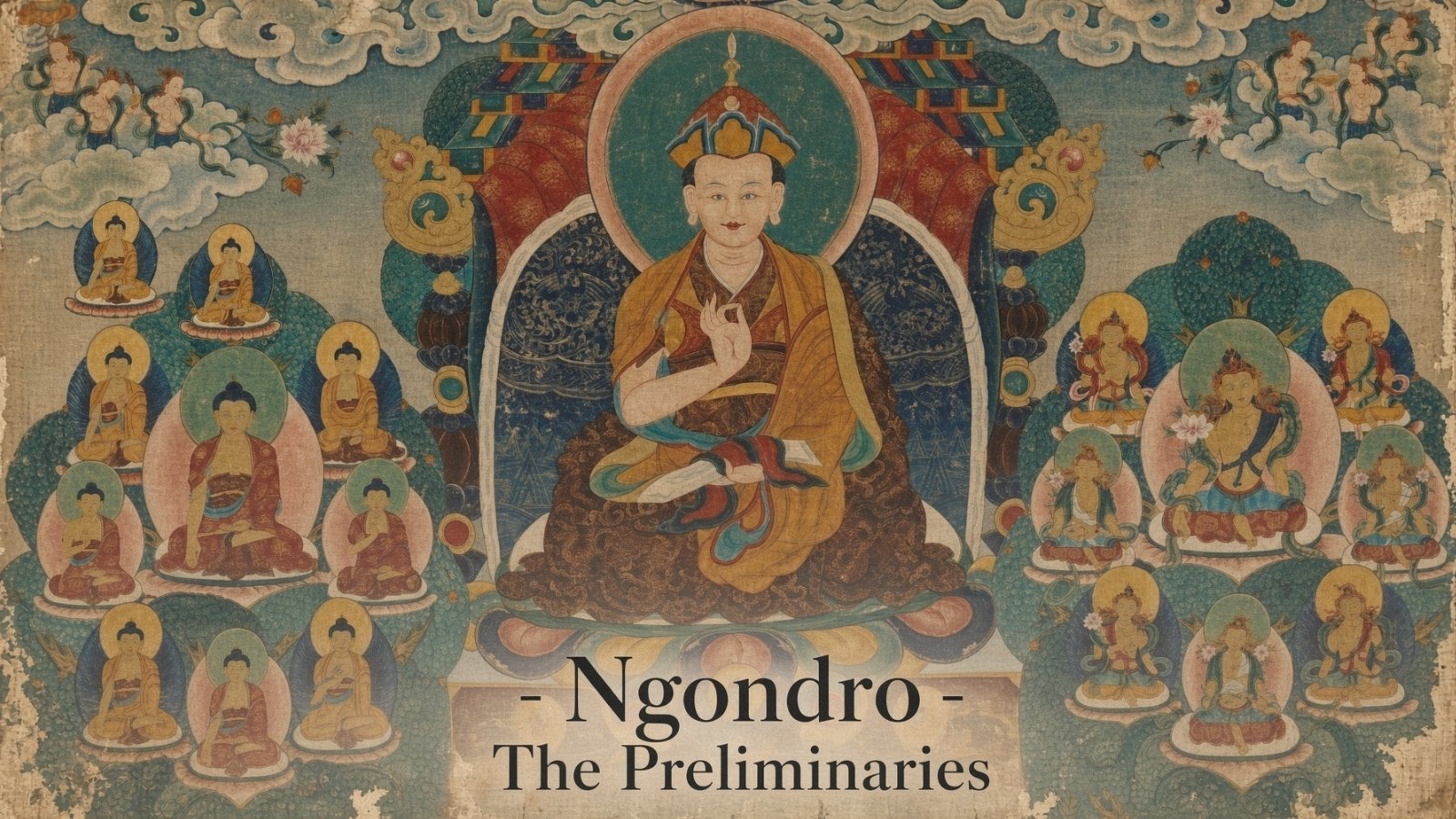
Ngondro literally means “that which goes before.” It is meant to prepare the practitioner for the so-called “actual practice”—literally, “that which is fundamentally central”—of Dzogchen, while also serving as a daily practice in its own right.
It belongs to the literature of preliminaries found throughout the schools of Vajrayana Buddhism. It begins with the common preliminaries, namely the four considerations that turn one away from samsara, intended to make the mind-stream workable, together with the four immeasurables, which train the mind.
These are followed by the special preliminaries:
- Going for refuge
- Developing the spirit of awakening
- Purification through the practice of Vajrasattva
- Gathering the accumulations through the Mandala offering
- Guru Yoga
A Dzogchen Ngondro
One of the distinctive features of the Kunzang Gongdu Ngondro is its content. Each of its customary branches refers, in both form and message, to the Great Completeness (Dzogpa Chenpo), providing a glimpse of and an entryway into its unique, all-encompassing perspective.
The Ngondro is therefore not merely a generic set of preliminary practices placed before Dzogchen. The view of Dzogchen is already woven into the practices themselves.
In preparation for the actual practice of Dzogchen, consisting of Tregchö—“cutting through what is seemingly solid”—and Thögal, “Crossing Over,” practitioners traditionally perform each of the five parts of the special preliminaries one hundred thousand times.
With such a requirement, many lay practitioners nowadays would otherwise spend many years completing the preliminaries before receiving or practising Dzogchen itself. Gangteng Tulku Rinpoche therefore graciously permitted practitioners to receive further instruction upon completing ten per cent of the prescribed number of repetitions, provided that they vow to complete the preliminaries within their lifetime.
This gives students an opportunity to engage in the study and practice of Ati Yoga while continuing to complete and deepen their practice of the Ngondro.
The lineage of transmission
The specific lineage of transmission, connecting the practitioner to an unbroken stream of blessings and realisation, is another element that sets the Kunzang Gongdü—an abbreviation of Künzang Gongpa Kündü, The Synthesis of the Entire Wisdom Mind of Samantabhadra—apart as a particular living practice tradition.
Each Vajrayana liturgy connects the practitioner to a specific lineage. In this case, it is a Dzogchen transmission lineage tracing its origin back to the primordial Buddha Samantabhadra and passing through figures such as Padmasambhava and Yeshe Tsogyal in the eighth century, Pema Lingpa in the fifteenth century, and the subsequent lineage holders of his revealed treasures, collectively known as the Pedling Chökor.
Among these lineage holders are Gyalse Pema Trinle, the first Gangteng Tulku in the sixteenth century; Dudjom Rinpoche Jigdral Yeshe Dorje, also known as Drodul Lingpa, in the twentieth century; and the current, ninth Gangteng Tulku, Kunzang Rigdzin Pema Namgyal.
Gangteng Tulku Rinpoche continues to bestow the teachings of Pema Lingpa’s Kunzang Gongdu Dzogchen cycle upon students who have completed the required preliminaries.
In Bhutan, the transmission continues in many of Rinpoche’s monasteries, retreat centres, and hermitages. Internationally, he teaches primarily through his Yeshe Khorlo centres.
Pema Lingpa and his revealed teachings
The revealer of the cycle, Pema Lingpa, was a fifteenth-century Bhutanese master and is considered one of the Five Sovereigns among the Treasure Discoverers, or one of the great Tertön Kings.
His revelations include the triad of core cycles of Guru, Great Completeness, and Compassionate Mind (bLa, rDzogs, Thugs gSum) traditionally associated with the revelations of a major treasure revealer.
The Guru teachings consist of peaceful and wrathful manifestations of Guru Rinpoche, specifically Lama Norbu Gyamtsho—The Guru Teachings, Like an Ocean of Jewels—and Guru Drakpo, the Wrathful Guru.
The Dzogpa Chenpo, or Great Completeness, teachings include the Father, Mother, and Child cycles:
Pha Dzogpachenpo — Künzang Gongpa Kündü Father Great Completeness — The Synthesis of the Entire Wisdom Mind of Samantabhadra
Ma Dzogpachenpo — Longsel Sangwa Nyingchu Mother Great Completeness — The Quintessence of the Luminous Expanse
Bu Dzogpachenpo — Nyimei Gyu Buchung Child Great Completeness — The Non-dual Tantra of the Small Child
Of these, the Kunzang Gongpa Kündü is currently among the most commonly practised. Its lineage remains alive, with numerous commentaries and many practitioners actively engaged with it both as a daily practice and in strict retreat.
The present liturgy
The present Ngondro liturgy was composed by Dudjom Rinpoche Jigdral Yeshe Dorje in Swayambhu, Nepal, in 1976, at the request of Gangteng Tulku Rinpoche, based on the root text of Pema Lingpa’s terma.
It provides a practical liturgy through which practitioners of this lineage can engage with the preliminary practices of the Kunzang Gongdu cycle as part of their daily practice and preparation for the further teachings of Dzogchen.
The app
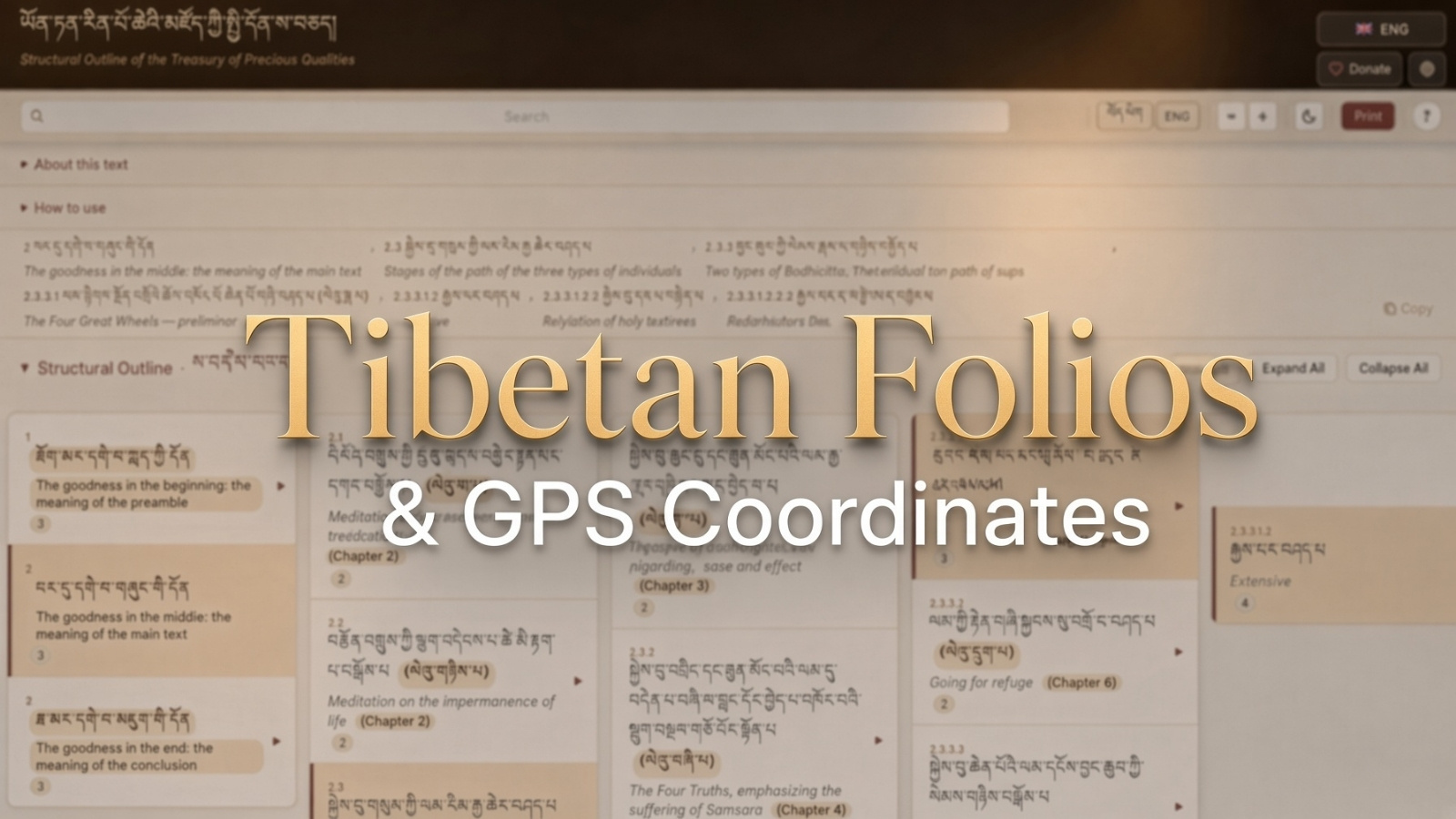
The interactive app is intended as a digital companion for the practitioner and was created to make reciting the text and contemplating its meaning as straightforward as possible in the digital age.
It can be installed on both iOS and Android devices and then accessed offline as a shortcut from the device’s home screen. It can also be used on a desktop computer, phone, or tablet, in either orientation.
Starting from the header, the app includes language selection—currently English and Polish, with more languages to follow—as well as independent selectors for the original Tibetan (chos skad) text, phonetic pronunciation guide, and translation. Each of these can be toggled on or off according to the practitioner’s needs.
An index allows the user to jump quickly to the relevant part of the liturgy, while the question-mark icon provides an overview of the app’s functionality.
The lower part of the screen includes automatic scrolling, with adjustable speed, particularly useful for hands-free recitation; a full-screen toggle; and a tilt-to-scroll function, which allows the text to be moved up or down simply by tilting the device.
The text also contains intervals at which the practitioner is instructed to remain in meditative equipoise. For those wishing to establish a regular daily period of meditation within the Ngondro practice, a digital timer is built into the app and can be activated at these specific points.
The countdown carries over from one section to the next.
For example, if you wish to spend sixty minutes meditating in the context of a complete Ngondro session, you can set the countdown by tapping the timer icon in the footer. When you reach a relevant section—such as the dissolution of the visualisation following refuge and bodhicitta—a play button appears.
Tap it and the countdown begins. If you wish to continue with the recitation after, for example, twenty minutes, simply pause the timer. When you reach the next section in which you are instructed to rest in equipoise, the timer will already display the remaining forty minutes.
A chime sounds once the full allotted meditation period has elapsed.
The app also includes a day/night toggle, particularly useful when practising at night, as well as text-size controls using the familiar minus and plus icons.
The iconography presented within the app includes static images of the Refuge Tree and Vajrasattva, as well as a visual aid for the Guru Yoga practice.
Within the Vajrasattva section, tapping the VISUALIZE button opens an interactive animation of the 100-syllable mantra, in which both the angle and speed of rotation of the mantra can be adjusted.
The importance of authentic transmission
Perhaps it goes without saying, but it bears repeating: this text is intended for those who have received at least its reading transmission (lung) from an authorised source.
Ideally, since it is a Vajrayana practice, one should also have received the corresponding empowerment (wang / dbang) and instructions.
The app is intended as an aid to practice, not as a replacement for transmission from a qualified lineage holder.
Please contact your local Yeshe Khorlo Centre if you wish to receive these transmissions or learn more about the practice.
Credits
Credit for the English-language translation on which the initial version of the text was based goes to Richard Barron and Sarah Harding.
The app was developed by Andrzej R. Rybszleger, interpreter and translator for Gangteng Tulku Rinpoche.
Explore the App Here